How Does Heat Affect Solar Inverters?
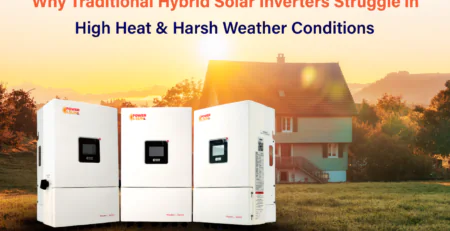
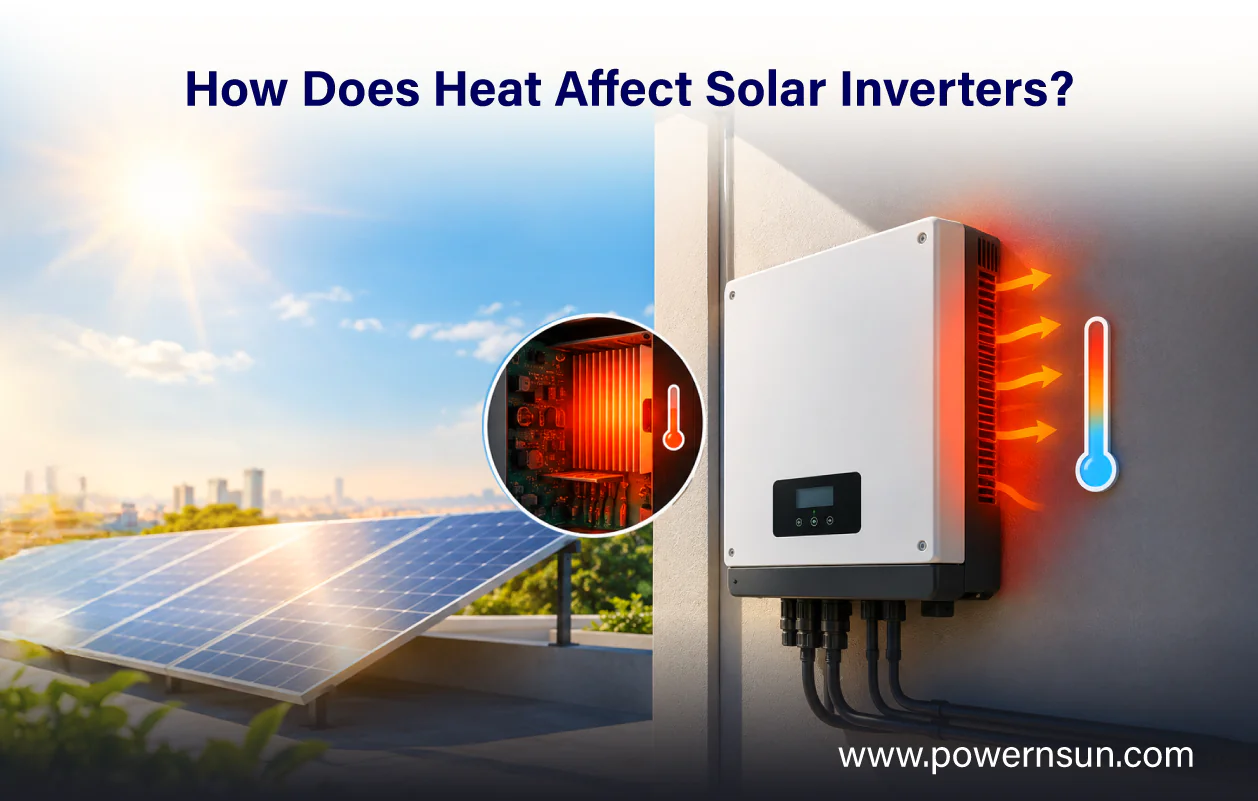
Heat makes a solar inverter reduce its own output on purpose. Most hybrid inverters deliver full Output Power to around 45 °C, then reduce output gradually, and shut down near 60 °C. This is called derating. It is protective behaviour, not a fault.
The important detail: The inverter reacts to its own internal temperature, not the weather forecast. A unit in direct sun can be 20 °C hotter inside than the air around it.
What Is Inverter Derating?
Derating is the inverter deliberately lowering its power output to keep its internal parts cool.
Heat shortens the life of the electronics inside, especially the capacitors, which smooth the electricity flow. A common engineering rule is that capacitor life roughly halves for every 10 °C rise.
So the inverter trades a little power today for years of extra service life.
At What Temperature Do Solar Inverters Start Derating?
Around 45 °C for most hybrid and string inverters, with full shutdown near 60 °C.
Exact figures differ by model and are published in the datasheet as a derating curve, which is simply a chart of output against temperature. Always ask for it. Any supplier who cannot produce one is worth questioning.
Why Is My Inverter Hotter Than the Outside Air?
Because of where it is mounted. Three things sit between the forecast and what the inverter feels.
| Cause | Extra heat inside the unit | Fix |
| Direct sun on the casing | 10 to 20 °C | Fit a shade cover. Cheapest fix there is. |
| Not enough clearance around it | 5 to 15 °C | Follow the manual. Free at installation. |
| Cupboard, garage corner or roof space | 5 to 25 °C | Ventilate or move it. Expensive later. |
A closed cupboard can add more heat than direct sunlight does.
How Do I Work Out What My Inverter Will Actually Deliver?
Take the hottest afternoon temperature at your site. Add the figure from the table above for how the unit is mounted. Open the datasheet, find the derating curve, and read across to that number.
That result is your real available output on the worst day of the year. Design around it, not around the figure printed on the box.
If the gap is large, you have three options: shade it, move it, or size up. The first two are almost always cheaper.
Why Does My Inverter Shut Down on Hot Afternoons?
Usually a mounting problem, not a broken inverter.
Check four things before replacing anything. Is the sun hitting it directly? Is there enough clear space around it? Is it in an enclosed cupboard or tight corner? And does the error log actually say overtemperature, or something else entirely?
Most cases turn out to have a low-cost fix.
Are Fanless Inverters Better in Hot Climates?
Not automatically, despite the marketing.
Fanless designs remove a moving part and remove a route for dust to get in. Both are real advantages in dusty conditions. But they cool passively, so they often begin derating sooner than a fan-cooled unit of the same rating.
Choose on the derating curve and on whether anyone will realistically service the unit. Not on whether it has a fan.
Does Heat Affect the Battery Too?
Yes, and in a hybrid system the battery usually reaches its limit first.
Most lithium batteries stop accepting charge around 50 °C and lose cycle life if they sit above roughly 35 °C for long periods. An inverter rated to 60 °C paired with that battery gives you a 50 °C system, whatever the inverter datasheet says.
Plan the installation space around the battery.
What About Coastal and High Altitude Sites?
Coastal: A high IP rating protects against dust and water but says nothing about salt. Ask for the C5-M marine corrosion grade in addition to the IP number.
Dusty inland: IP65 and IP66 are both fully dust proof. The real question is whether filters can be reached and cleaned. Ask about the service interval.
High altitude: Thinner air cools less effectively. Many inverters begin derating above 2,000 metres. Check the datasheet, as the threshold varies by model.
What Should I Ask a Supplier?
Five questions. Output at 45 °C. Output at 50 °C. The altitude at which derating starts. The corrosion grade. The fan replacement interval, if it has fans.
Ask them to name the standards too: IEC 62109 for safety, IEC 61683 for comparable efficiency figures, IEC 60068-2 for heat and salt spray testing, ISO 9223 for corrosion grade.
A supplier who answers with these numbers has read the paperwork. One who answers with adjectives has not.
How Does This Work on a Real Project?
From supply to successful commissioning
Power & Sun supplied a 20 kW hybrid inverter and a 90 kWh battery energy storage system (BESS, a large battery bank that stores solar power for later use) for the ADNOC Service Station on Al Jubail Island, Abu Dhabi. The system uses our Ultimatte Series hybrid inverter and Tusk Series BESS, and we supported it from supply through to commissioning.
The site is on the coast, and summer afternoons in Abu Dhabi regularly pass 45 °C. That combines the two challenges covered in this guide: heat that pushes an inverter into derating, and salt air that attacks its casing. A battery bank of this size also needs protecting, because in a hybrid system the battery usually reaches its temperature limit first.
Frequently Asked Question
Does derating damage my inverter?
No. Derating is the protection. The real risk comes from an inverter that runs hot for years, which wears out components faster. Occasional derating is normal. Regular afternoon shutdowns are a sign that the installation needs attention.
Does heat also reduce solar panel output?
Yes, separately from the inverter. Panels typically lose around 0.3 to 0.5 percent of output for every degree their cells rise above 25 °C. On a South African roof in summer, cells often run 20 to 30 °C hotter than the air. Check the temperature coefficient on the panel datasheet.
Is heat derating covered by my inverter warranty?
Derating is designed behaviour, not a fault, so it is not a warranty claim. Heat damage caused by ignoring the manufacturer’s clearance or ventilation requirements may void the warranty. Read the installation conditions in the warranty terms before mounting.
Can I install my inverter outdoors?
Yes, if its IP rating allows outdoor use (IP65 or higher is typical) and it is kept out of direct sun. In South Africa, a south-facing wall or a wall under a roof overhang gets the least direct sunlight through the day.