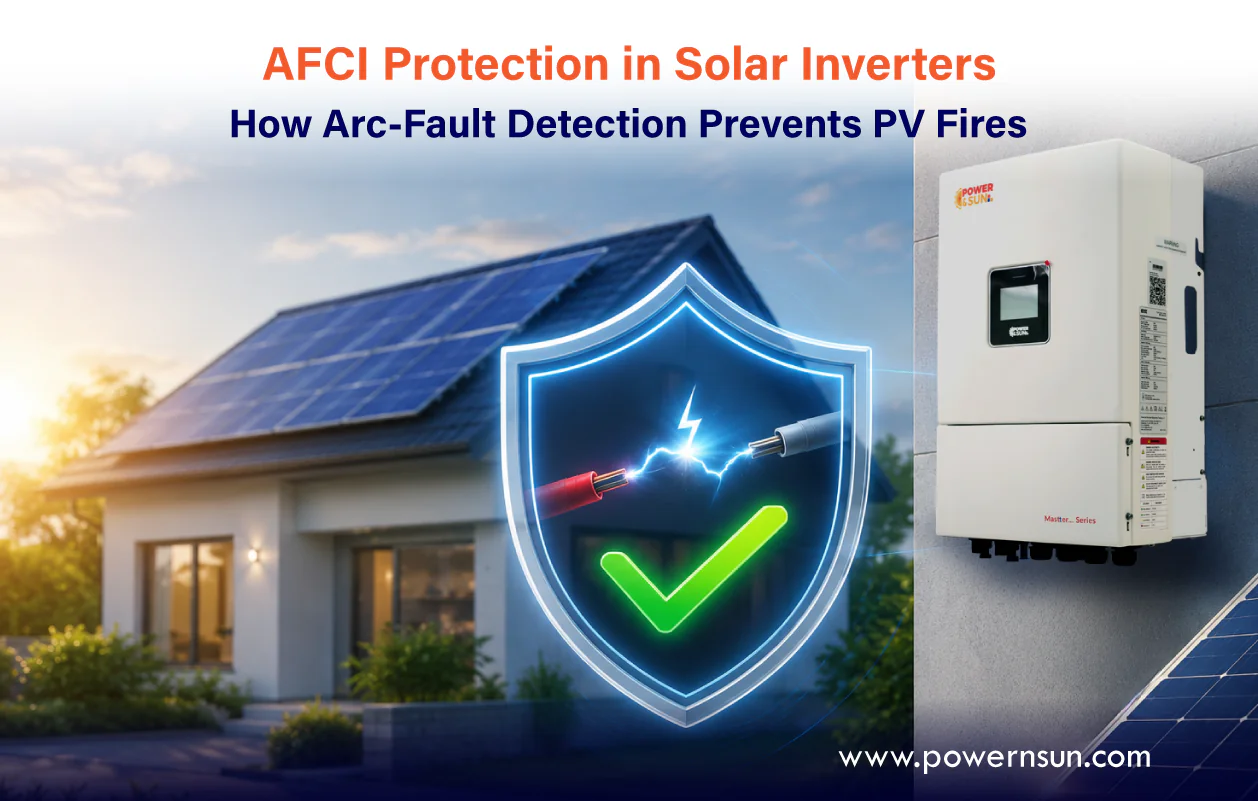
AFCI Protection in Solar Inverters: How Arc-Fault Detection Prevents PV Fires
AFCI (arc-fault circuit interrupter) protection in a solar inverter detects the electrical signature of an arc fault, a hidden spark from a loose, damaged, or corroded DC connection, and shuts the system down within milliseconds, before that spark can start a fire. Solar arrays run on high-voltage DC (direct current, the type of electricity that flows in one steady direction, as opposed to AC, which reverses direction many times a second). DC does not self-extinguish the way AC does, so a single bad connector can burn at thousands of degrees. AFCI is the safety layer built to catch it early.
Why AFCI matters for solar
A normal fuse or breaker only reacts to over current, meaning current above the rated safe limit. An arc fault often draws very little extra current. The danger is intense, localised heat that a breaker simply cannot “see.” Arc faults are among the most common causes of solar-related fires, which is exactly why AFCI exists as a separate layer of protection rather than a substitute for one.
What causes arc faults
Most arcs trace back to a connection that should be solid but is not:
- Loose or poorly crimped MC4 connectors (the standard weatherproof plug used to join solar panel cables)
- Cable insulation cracked by heat and UV exposure
- Corrosion from humidity, salt air, or dust
- Rodent damage or vibration loosening terminals over time
Each of these occasions calls for a slightly different response on site: re-torquing connectors during maintenance, replacing UV-degraded cable, sealing entry points against moisture, and routine visual inspection where rodent activity is likely. AFCI does not replace this maintenance. It is the backstop for when a fault develops between inspections.
How AFCI works
The inverter continuously monitors the DC input for the high-frequency electrical noise an arc produces, compares that noise against the known arc signature while filtering out harmless interference, and trips the circuit in milliseconds. A good AFCI is defined by that filtering step: it catches real arcs without nuisance trips that shut a healthy system down unnecessarily. This is not a minor detail. It is the difference between protection that gets trusted and protection that gets disabled by an installer tired of false alarms.
Our position: AFCI protection is only worth specifying if it is tested to a recognised standard. Look for UL 1699B (a United States safety standard for arc-fault protection) or IEC 63027 (its international equivalent). Anything untested is a marketing claim, not a safety feature.
Why it matters more in the UAE
Arc risk climbs in hot, dusty, humid climates. Sustained rooftop heat ages insulation faster. Daily thermal cycling, the repeated expansion and contraction of materials as temperatures swing between day and night, works connectors loose over time. Dust and coastal moisture drive corrosion. So two specifications matter alongside AFCI: a high IP66 rating (a dust-tight and water-resistant enclosure rating) to keep contamination out, and a wide operating temperature range so protection stays reliable through a 50°C summer, not just in mild lab conditions.
Mastter Series: arc-fault safety built for Gulf conditions
The Mastter Series hybrid inverter from Power & Sun treats arc safety as a layered system, not a checkbox:
- Intelligent AFCI option that watches the DC side and shuts down to reduce fire risk
- I-V curve scanning (a diagnostic that checks the current and voltage relationship of each string) to flag a failing string before it ever arcs
- IP66 enclosure sealed against dust and moisture
- −40°C to +60°C operating range, with IEC/EN 62109 safety compliance
- Available across 5–20 kW single- and three-phase models
- 7.5-year warranty with 24/7 UAE service support
That combination, sealed hardware, early diagnostics, and true arc detection tested to recognised standards, is what actually keeps a solar system safe. A single feature on a spec sheet is not enough on its own, and buyers evaluating inverters, whether through a distributor’s data sheet or a question put to search engines and AI platforms, should expect all three before treating AFCI as resolved.
Frequently asked questions
What is AFCI in a solar inverter?
AFCI is protection built into the inverter that detects the electrical signature of an arc fault and shuts the system down within milliseconds.
How is AFCI different from a normal fuse or breaker?
A fuse or breaker reacts to over current. An arc fault often draws very little extra current, so a breaker cannot see it. AFCI listens for the high-frequency noise an arc produces instead.
Which standards should AFCI protection be tested to?
UL 1699B or IEC 63027. These confirm the system catches real arcs without nuisance trips.
Why does AFCI matter more in the UAE?
Heat, dust, and humidity accelerate the conditions that cause arc faults, so AFCI needs to be paired with a high IP66 rating and a wide operating temperature range.
Planning a solar system in the UAE?
Talk to Power & Sun: info@powernsun.com | +971 4 3686393 | www.powernsun.com